Airport Security Systems: How to Secure Airports with Integrated Video Surveillance and Access Control

An airport is one of the hardest environments in physical security. A single mid-size hub runs hundreds of cameras, dozens of controlled doors and gates, kilometers of perimeter fence, and a stream of passengers, staff, vehicles, and baggage that never stops. To secure an airport, none of these can be watched in isolation. A modern airport security system ties video surveillance, access control, and AI video analytics into one platform, so a single operator can see a perimeter breach, the door it leads to, and the person who triggered it as one connected event.
This guide explains what an airport security system is, how its core technologies work together, and how to choose and implement one. It is written for security directors, airport IT teams, and the system integrators who design these projects. It covers the full stack of airport security systems, from CCTV and access control to AI analytics, perimeter protection, and the unified video management system (VMS) that runs underneath.
Table of Contents
- What Is an Airport Security System?
- Airport CCTV Systems
- Airport Access Control Systems
- AI Video Analytics for Airport Security
- How Integrated Security Helps Secure Airports
- Benefits of Integrated Airport Security Systems
- Best Practices for Airport Security
- How to Choose an Airport Security System
- Why Axxon One for Airport Security
- FAQ
What Is an Airport Security System?
An airport security system is the combined set of technologies and procedures that protect an airport's people, infrastructure, aircraft, and operations against intrusion, theft, terrorism, and disruption. In practice it is rarely a single product. It is a layered architecture in which several subsystems share data and feed one operational picture.
The core components of a modern airport security system are:
- Video surveillance (CCTV) covering terminals, aprons, runways, and the perimeter with fixed, PTZ, panoramic, and thermal cameras.
- Access control that governs who enters restricted areas such as the airside, baggage handling, control towers, and server rooms.
- AI video analytics that interpret the camera feeds in real time, detecting intruders, classifying objects, recognizing license plates, and flagging abandoned baggage.
- Perimeter protection built from fence sensors, radar, and analytics that secure the boundary before an intruder reaches the apron.
- A video management system (VMS) or PSIM platform that records, manages, and correlates everything above into a single interface.
The defining trait of a strong airport security system is integration. A camera that only records is a forensic tool, useful after an incident. Tie that camera into analytics, access control, and an alarm workflow and it becomes a preventive one, raising an alert while there is still time to respond. That shift from recording to prevention is what separates a collection of devices from a true airport security solution.
Where airport security gets applied
A complete system has to serve very different zones at once:
| Zone | Primary risk | Typical technology |
|---|---|---|
| Perimeter & airfield | Intrusion, runway incursion | Thermal cameras, radar, perimeter analytics |
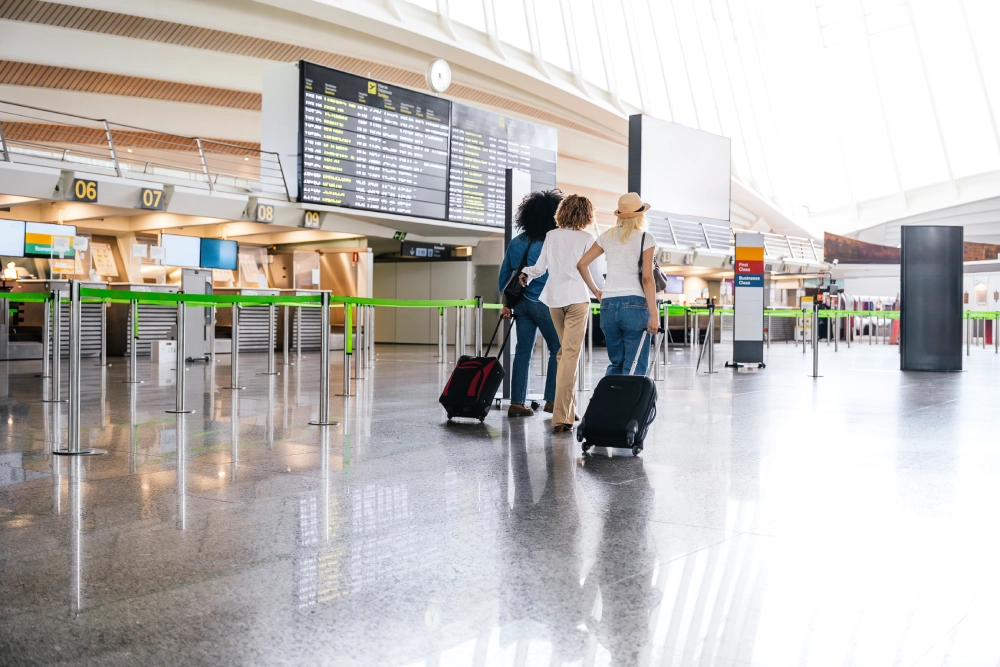
| Terminal (landside) | Crowds, theft, unattended items | High-density CCTV, crowd & abandoned-object analytics |
| Restricted / airside | Unauthorized access | Access control plus video verification |
| Baggage handling | Theft, tampering, tracking | CCTV with object tracking, access control |
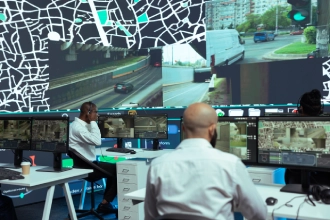
| Security Operations Center | Slow or missed response | Unified VMS, alarm management, video walls |
Airport CCTV Systems
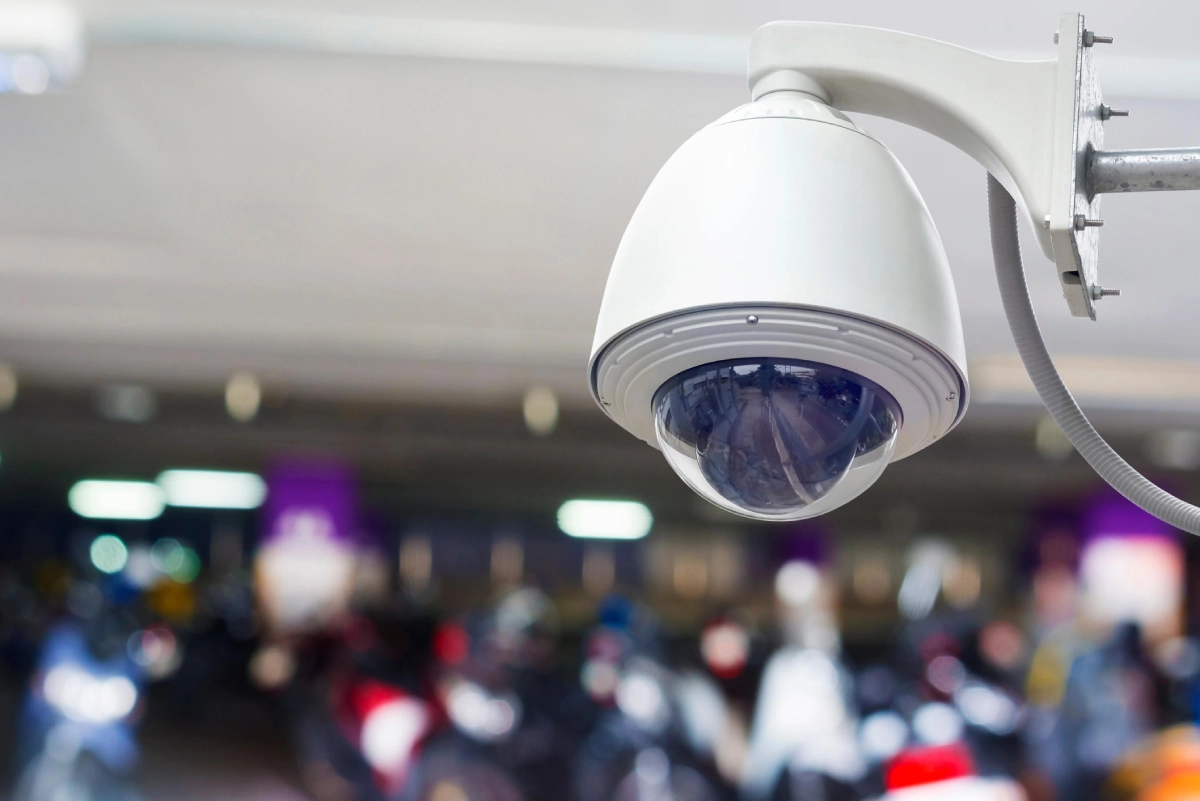
Airport CCTV is the backbone of the whole operation. It is also the layer where scale becomes a real engineering problem. A large international hub can operate well over ten thousand cameras, and the system has to record all of them continuously, keep that footage for the retention period set by aviation regulators, and still let an operator pull any stream instantly.
Effective airport video surveillance depends on choosing the right camera for each environment:
- Terminal halls and concourses: high-resolution fixed and multi-sensor cameras for face-height coverage and wide situational views.
- Aprons and runways: long-range PTZ and panoramic airport surveillance cameras that follow aircraft and ground vehicles.
- Perimeter and airfield at night: thermal and low-light airport security cameras that see through darkness, fog, and glare.
- Baggage and cargo areas: cameras paired with tracking analytics to follow an item across handovers.
The cameras are only half the system. The other half is the software that ingests, compresses, stores, and serves the video. This is the job of the airport video management system, the airport VMS. A capable VMS handles bandwidth and storage efficiently with H.265, motion-based recording, and edge buffering. It supports failover so no stream is ever lost. And it gives operators the tools that matter at scale: instant smart search, time-synchronized multi-camera playback, and forensic export that holds up in court.
A common mistake is treating CCTV as a closed circuit that only feeds monitors and a recorder. In a modern airport surveillance solution, the video layer is open and integrated. Every camera becomes a sensor that analytics can read and that access control and alarm workflows can act on.
Study CasesAirport Access Control Systems
If CCTV answers "what is happening," airport access control systems answer "who is allowed where." Airports are divided into security zones with strict separation between public landside areas and restricted airside, baggage, maintenance, and operational areas. Access control enforces that separation.
A typical airport access control system manages:
- Credentials and identity: staff badges, biometrics, and multi-factor checks for the most sensitive zones.
- Doors, gates, turnstiles, and mantraps: controllers that lock and unlock based on permissions, time schedules, and anti-passback rules.
- Vehicle access: barriers and gates at service roads and cargo entrances, often tied to license plate recognition.
- Audit and compliance: a full log of every access event, which aviation regulators require for restricted areas.
On its own, access control has a blind spot. It authenticates a credential, not a person, and a badge can be lost, shared, or cloned. This is why airport access control systems deliver far more value once they are integrated with video. When a credential is used at a restricted door, the system pulls the live camera at that door so an operator confirms that the person matches the badge holder. A door forced open, a tailgating attempt, or an after-hours entry becomes a video-verified alarm instead of a line in a log file no one reads.
That pairing of an access event with its matching video is the first and most practical step toward an integrated airport security system, and it is where most airports see the fastest operational payoff.
Study IntegrationsAI Video Analytics for Airport Security
AI video analytics is what turns a wall of monitors into an alerting system. No operator can watch thousands of feeds at once, and human attention degrades within minutes of staring at a video wall. AI airport surveillance moves the watching to software and reserves human attention for decisions.
Neural-network analytics relevant to airport security include:
- Intrusion and perimeter detection that flags a person or vehicle crossing into a restricted zone, with far fewer false alarms than legacy motion detection.
- Object classification that distinguishes people, vehicles, and aircraft, so the system alerts on a human on the apron but ignores a passing baggage cart.
- Abandoned and removed object detection that raises an alarm on an unattended bag in a concourse or a removed item from a secured area.
- License plate recognition (LPR) that controls and logs vehicle access at service gates and cargo entrances.
- Face recognition that supports watchlist matching and access verification where regulation permits.
- Crowd and queue analytics that measure density at checkpoints and gates to prevent dangerous crowding and ease passenger flow.
- Fire and smoke detection that spots early signs of fire in areas a smoke detector may miss.
The job of analytics in an airport is filtering. A perimeter line might be crossed by wildlife, weather, or shadows hundreds of times a day. Good analytics suppress that noise and surface the one event that matters, with the video clip attached, routed to the right operator with a recommended action. That separates an alert operators trust from one they learn to ignore.
Study AI & AnalyticsHow Integrated Security Helps Secure Airports
The technologies above each solve a piece of the problem. They protect an airport far better when they work as one system, because integration is what lets an airport move from reacting to incidents to preventing them.
Consider how a unified platform handles the core airport security scenarios:
- Perimeter protection. Radar or fence sensors detect movement at the boundary. The nearest airport surveillance camera slews to the location, AI analytics classify the target as a person rather than an animal, and the operator gets one alarm with live video and a map position before the intruder reaches the apron.
- Terminal surveillance. Crowd analytics flag dangerous density at a checkpoint. Abandoned-object detection flags an unattended bag so that the operator can pull the footage of who left it and trace their path backward through the terminal.
- Baggage monitoring. Cameras and tracking analytics follow an item through handover points, and any access to a baggage area is logged against the badge that opened the door and matched to video.
- Restricted area access. A credential at an airside door triggers video verification, and a forced or tailgated entry escalates to a video alarm with the relevant streams already on screen.
- Incident response. Every subsystem feeds one Security Operations Center (SOC), so the operator sees the alarm, the live and recorded video, the access event, and the location together, then follows a defined response procedure instead of switching between disconnected applications.
The thread running through all of these is correlation. An integrated airport security system connects a perimeter sensor, a camera, an access event, and an analytics alert into one incident. That is how integration helps secure airports in practice: it compresses detection, verification, and response into a single, fast workflow.
Benefits of Integrated Airport Security Systems
Pulling CCTV, access control, and analytics onto one platform delivers measurable operational gains over running each as a silo:
| Benefit | What it means for the airport |
|---|---|
| Faster response | One alarm carries video, location, and access data together. No app-switching, no manual correlation. |
| Fewer false alarms | AI analytics filter noise, so operators act on real events and keep trusting the system. |
| Lower operator load | Software watches the feeds and staff handle decisions, so a small team covers a large site. |
| Stronger compliance | A unified audit trail across video and access satisfies aviation regulators and simplifies reporting. |
| Single source of truth | Investigations pull synchronized video and access records from one platform, not five. |
| Lower total cost | One platform, one training curve, and open hardware support avoid vendor lock-in and duplicated infrastructure. |
| Room to scale | New terminals, cameras, and sites join the same system instead of becoming new islands. |
The strategic benefit sits above all of these. An integrated platform turns security from a cost center that documents incidents into an operational system that helps prevent them and improve passenger flow at the same time.
Best Practices for Airport Security
Designing an airport security system is an exercise in layering and integration. The practices below reflect how mature aviation security programs are built, and two real AxxonSoft airport deployments illustrate them.
- Design in security layers: perimeter, airfield, terminal, restricted zones, and SOC, each with its own detection and response logic.
- Choose an open platform so cameras, access control, sensors, and analytics from different vendors run on one VMS.
- Integrate video with access control from day one and video-verify every restricted-area event.
- Apply AI analytics where attention fails: perimeter, abandoned objects, crowding, restricted zones.
- Build redundancy with server failover and recording redundancy so no stream or event is ever lost.
- Centralize in a SOC with clear, documented response procedures per alarm type.
- Plan for scale and retention: size storage, bandwidth, and footage retention to regulation and growth.
- Train operators on workflows, not only software. The platform helps only when the response procedure is rehearsed.
Blueprint in practice: a unified system for Terminal 3, Lanzhou
At Lanzhou Zhongchuan International Airport, a new terminal called for a single security system rather than a patchwork of subsystems. The blueprint followed the integration-first principle: video surveillance, access control, and alarm management were unified on one AxxonSoft platform, so terminal operators work from one interface across all security functions. The lesson for any Terminal 3–class project is to specify unification as a requirement up front. Retrofitting integration onto separately procured systems costs far more than designing for it.

Blueprint in practice: AI-powered security at Mexico City International Airport
At Mexico City International Airport (AICM), the emphasis was on AI video analytics layered onto large-scale surveillance, using neural-network detection to extend a finite security team across one of Latin America's busiest hubs. The takeaway: at high passenger volumes, analytics are the only realistic way to maintain coverage, because human attention does not scale with camera count.
How to Choose an Airport Security System
Selecting an airport security software platform is a long-term decision. The system will run for many years and absorb new terminals, cameras, and regulations along the way. Evaluate vendors against criteria that predict how the system performs at scale and over time, not against a one-off demo.
| Selection criterion | What to look for | Why it matters at an airport |
|---|---|---|
| Open platform | Broad camera, access control, and sensor support via ONVIF and direct integrations | Avoids lock-in and lets you choose best-in-class hardware per zone |
| Scalability | Proven multi-thousand-camera, multi-site deployments | Airports only grow, and the platform must grow with them |
| AI analytics depth | Built-in neural detectors for intrusion, objects, LPR, crowds | Filtering noise is what makes monitoring viable |
| Integration breadth | Native access control, intrusion, perimeter, fire, and PSIM-level correlation | Integration is the whole point of the system |
| Reliability | Server and recording failover, no single point of failure | An airport cannot afford lost footage or downtime |
| Cybersecurity | Encryption, role-based access, hardening, compliance posture | Security software is itself a target |
| Operator experience | Fast smart search, clear alarm workflows, video wall, mobile | Determines real-world response speed |
| Compliance & support | Audit trails, retention controls, global support and integrator network | Aviation regulation is non-negotiable |
A practical way to run the evaluation: define your zones and risks first, list the cameras, access points, and sensors each zone needs, then test whether each candidate platform can manage all of them as one system with the analytics and workflows your operators will actually use. The platform that scores well on integration and scale will serve the airport far longer than the one that wins on a single flashy feature.
Why Axxon One for Airport Security
Axxon One is AxxonSoft's open-platform video management system with built-in AI video analytics, and it maps directly onto what an airport security system needs.

Axxon One supports a wide range of camera and device makes via ONVIF and direct integrations, so an airport can deploy best-in-class airport surveillance cameras per zone and still run everything as one system, with no vendor lock-in.

Neural-network detectors handle the airport-critical jobs of perimeter intrusion, object classification, abandoned and removed objects, license plate recognition, face recognition, and crowd analytics, filtering noise so operators act on real events.

Axxon One brings video, access control, perimeter protection, and alarms into one interface, so a credential event, a sensor trip, and the matching camera become a single correlated incident.

A distributed architecture with failover is built for large, multi-site, always-on environments, exactly the profile of an international airport.
For an airport that wants one platform to secure the perimeter, the terminal, restricted zones, and baggage, and to keep scaling as it grows, Axxon One delivers the open, AI-driven, unified foundation the job requires.
FAQ
What is an airport security system?
An airport security system is the integrated set of technologies — video surveillance (CCTV), access control, AI video analytics, intrusion detection, perimeter protection, and a managing VMS or PSIM platform — that together protect an airport's people, infrastructure, aircraft, and operations. Its defining feature is integration: the subsystems share data so detection, verification, and response happen as one workflow.
How does airport CCTV work?
Airport CCTV uses a mix of fixed, PTZ, panoramic, and thermal cameras to cover terminals, parking spaces, aprons, runways, and the perimeter. The cameras stream to a video management system that records and stores the footage, often using H.265 compression and failover to handle scale, and gives operators tools like smart search and synchronized multi-camera playback to review any moment instantly.
Why do airports need access control systems?
Airports are split into public and restricted zones, and access control enforces the boundary by governing who may enter airside areas, baggage handling, control towers, and other sensitive spaces. It also produces the audit trail of every access event that aviation regulators require. Tied to video, access control lets operators visually verify that the person using a credential is its rightful holder.
What technologies improve airport security?
The biggest gains come from integrating four layers: CCTV for situational awareness, access control for restricted zones, AI video analytics for automatic detection, and perimeter protection for the boundary, all unified on one VMS. Integration matters more than any single technology, because it turns disconnected tools into one preventive system.
How is AI used in airport surveillance?
AI video analytics interpret camera feeds in real time so software, not operators, watches the wall of screens. In airports it detects perimeter intrusions, classifies people versus vehicles, flags abandoned or removed objects, reads license plates, supports face-watchlist matching, and measures crowd density, surfacing the events that matter with video attached and suppressing false alarms.
What is airport perimeter security?
Airport perimeter security protects the airfield boundary against intrusion. It combines fence sensors, radar, and thermal cameras with AI analytics that classify what crossed the line, so a real intruder triggers an alarm with live video and a map position while wildlife or weather is filtered out, giving the airport time to respond before anyone reaches the apron or aircraft.
How are restricted areas monitored?
Restricted areas are monitored by pairing access control with video verification. A credential used at a restricted door can automatically pull the live camera at that door, and events like a forced door, tailgating, or after-hours entry escalate into video alarms. Every access event is logged against a badge and matched to footage for investigation and compliance.
What should organizations consider when choosing an airport security system?
Prioritize an open platform with broad camera and device support to avoid lock-in, proven scalability to thousands of cameras and multiple sites, depth of built-in AI analytics, integration breadth across access control and perimeter, reliability with failover, cybersecurity, operator workflow quality, and compliance and support. Integration and scale predict long-term value better than any single feature.
What is a VMS in airport security?
A VMS (video management system) is the software platform that records, stores, and manages all of an airport's video and, in an integrated system, correlates it with access control and analytics. The VMS is the layer that turns thousands of cameras and sensors into one operational picture in the Security Operations Center. Axxon One is an example of an open-platform VMS with built-in AI analytics designed for this scale.
Volver al blog